The short answer
The best electric air duster is not necessarily the one with the largest RPM number. Choose by the work you actually need to do: controllable airflow for delicate gaps, attachments that fit the openings you clean, charging and runtime wording you can verify, and either an air-only or blow-and-vacuum workflow. RPM describes motor rotational speed. By itself, it does not tell you airflow volume, air pressure, nozzle efficiency, noise, runtime, or how safely the tool can be controlled around a particular surface.
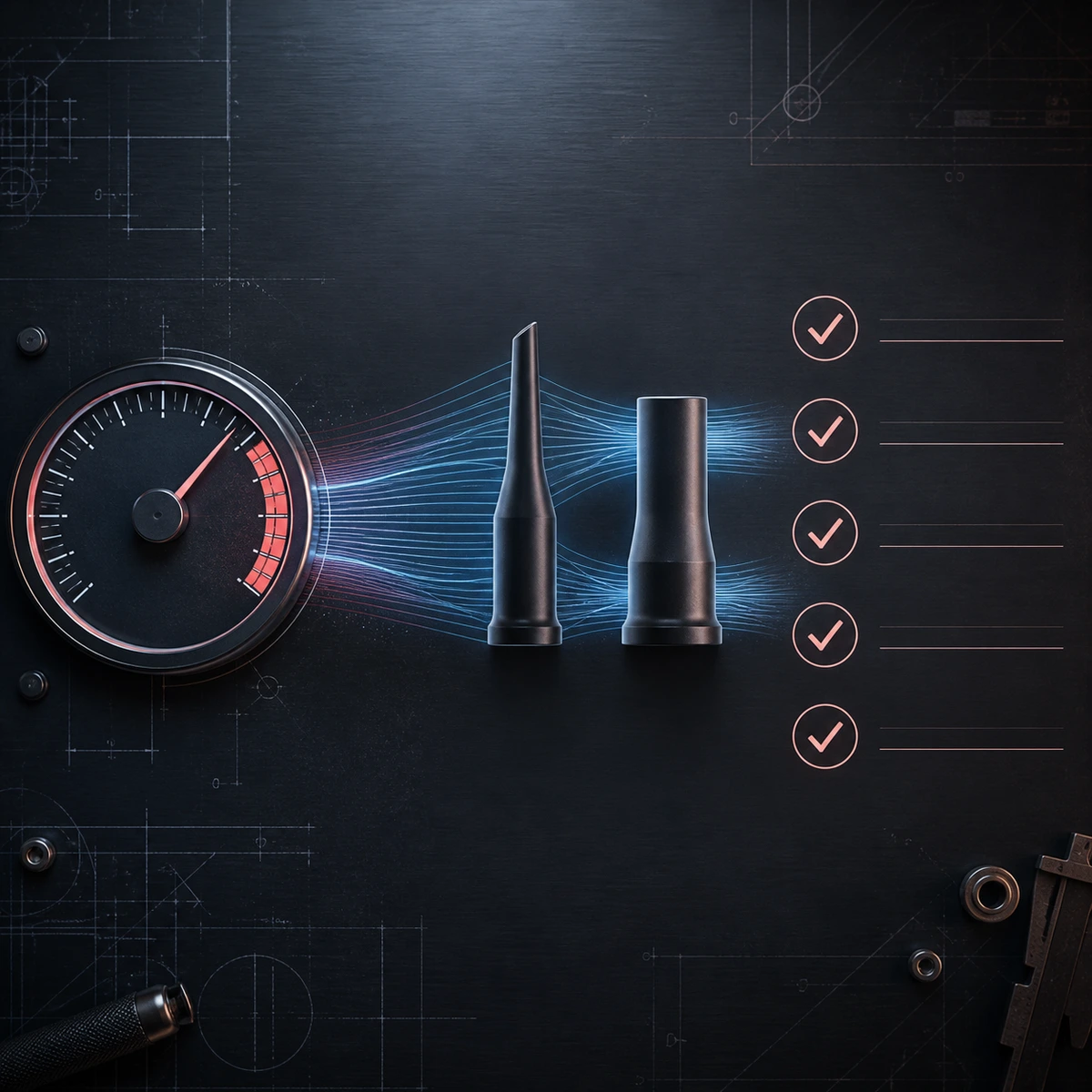
A useful buying decision starts with five questions:
- Do you need to loosen dust only, or collect it afterward too?
- Can you start at a low output and increase it gradually?
- Are the included attachments suited to the gaps and surfaces you clean?
- Are charging time and runtime claims stated with their conditions?
- Does the product documentation explain safe operation, heat, filters, and care?
- That framework is more dependable than choosing from a single headline specification.
Start with the cleanup pattern, not the product label
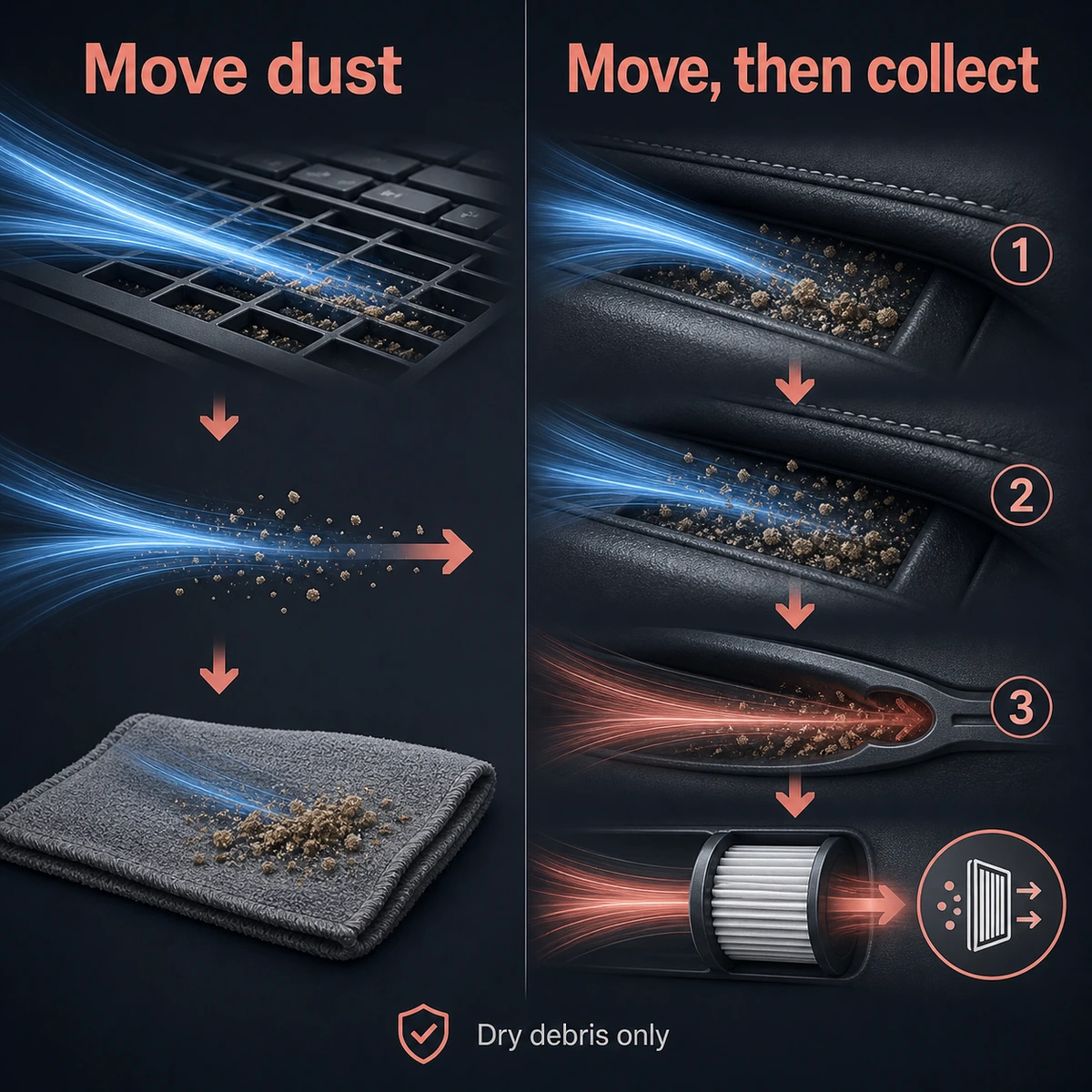
“Electric air duster” covers tools with different jobs. Some are compact, air-only devices made to move loose dust from narrow, externally accessible spaces. Others combine blowing with a handheld vacuum so you can loosen debris and then collect it.
Air-only operation makes sense when portability, a narrow body, and precise airflow control matter most. Think of keyboard edges, external computer grilles, desk equipment, car vents, or window tracks. The important point is that displaced dust still needs somewhere safe to go. You may need a cloth, a conventional vacuum used nearby, or a second cleanup pass after the dust settles.
A blow-and-vacuum design is useful when the same job includes both releasing debris from a seam and picking it up from a reachable surface. Vacuum mode adds its own maintenance: the filter must be installed correctly, the cup must be emptied, and washed components must be completely dry before reassembly. A handheld unit also does not become suitable for liquid pickup unless the manufacturer explicitly says so.
POWCUBE’s current line illustrates the distinction. FT-03’s stepless air-only design prioritizes compact detail cleaning. FT06’s blow-and-vacuum workflow adds four selectable levels, a filtered vacuum mode, and an LED work light. Neither pattern is universally better; they solve different cleanup sequences.
RPM is motor speed, not a complete measure of cleaning performance
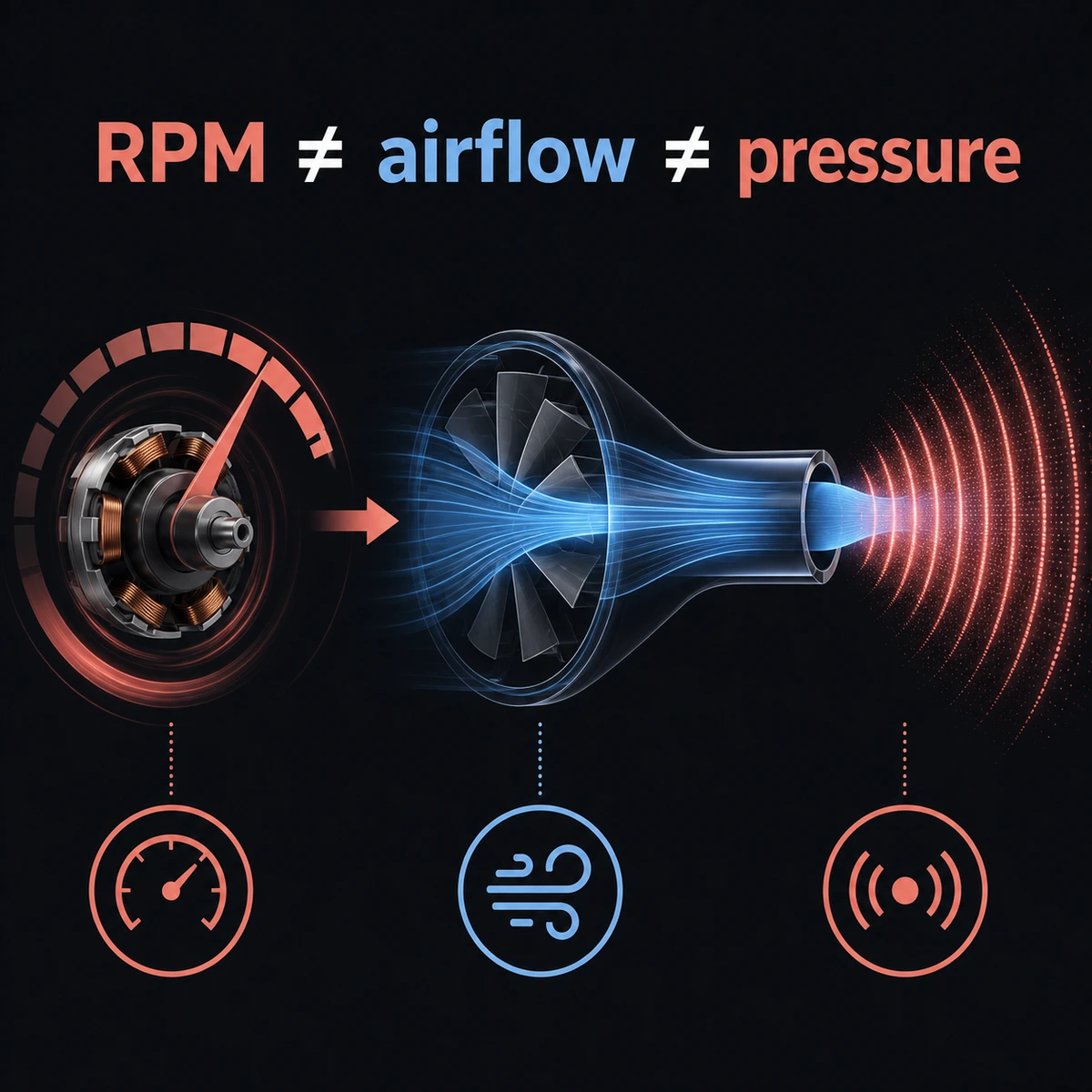
RPM means revolutions per minute. On an electric duster, it normally describes how quickly the motor rotates under the stated test or design condition. It can be a legitimate product specification, but it is not interchangeable with airflow or pressure.
Airflow volume is commonly expressed as cubic feet per minute (CFM) in the United States. Pressure may be reported in pascals, kilopascals, inches of water, or another unit depending on the device and test. The nozzle and internal air path affect how the moving air reaches the target. A narrow nozzle may create a more focused jet at a small opening, while a wider outlet may move air across a larger area. Those are different outcomes even when the motor-speed number looks similar.
If a listing gives RPM but no comparable airflow or pressure test, treat RPM as one design detail, not a winner-takes-all score. POWCUBE states maximum motor speeds of 150,000 RPM for FT-03 and 180,000 RPM for FT06. Those figures should not be presented as direct proof that one unit produces a specific CFM, cleans a PC better, or is safer for delicate electronics.
| Specification | What it can tell you | What it cannot prove by itself |
|---|---|---|
| Motor RPM | Maximum stated rotational speed | CFM, pressure, cleaning result, noise, or runtime |
| Airflow volume | Amount of air moved under a defined test | How focused the outlet feels at every nozzle |
| Air pressure | Force under a defined condition | Total air volume or suitability for delicate parts |
| Vacuum pressure | Suction capability in vacuum mode | Blower performance or debris pickup in every setup |
| Battery capacity | Stored charge under the stated rating | Actual runtime at every output level |
Control matters more than maximum output for many detail jobs
A high maximum setting is useful only if the tool also gives you a sensible way to avoid using it everywhere. Around external electronics, vents, keys, light trim, and loose debris, the practical question is whether you can start gently.
Stepless control lets you move through a continuous range. Fixed levels give you repeatable steps. Neither interface wins in every situation. A stepless slider may suit someone who wants fine adjustment while moving between narrow gaps. Defined levels may be easier when you want a predictable setting for repeated tasks.
For cleaning electronics, power down and disconnect the device when its manufacturer instructs you to do so. Work only on externally accessible areas unless you are qualified and the device documentation provides a safe procedure. Do not let airflow spin an exposed fan freely at high speed, do not open a power supply, and do not introduce liquid cleaner with the air stream.
- Does the unit start at its lowest setting, or does it resume the last setting?
- Can you change output without shifting your grip toward the nozzle?
- Is the shutoff action obvious?
- Does the manual explain what happens if thermal protection reduces or pauses output?
- Can the intake and outlet remain unobstructed in a normal grip?
Match attachments to an escape path for the dust
An attachment is useful when it directs air without sealing the opening or contacting a sensitive surface. More pieces in the box do not automatically mean a better kit.
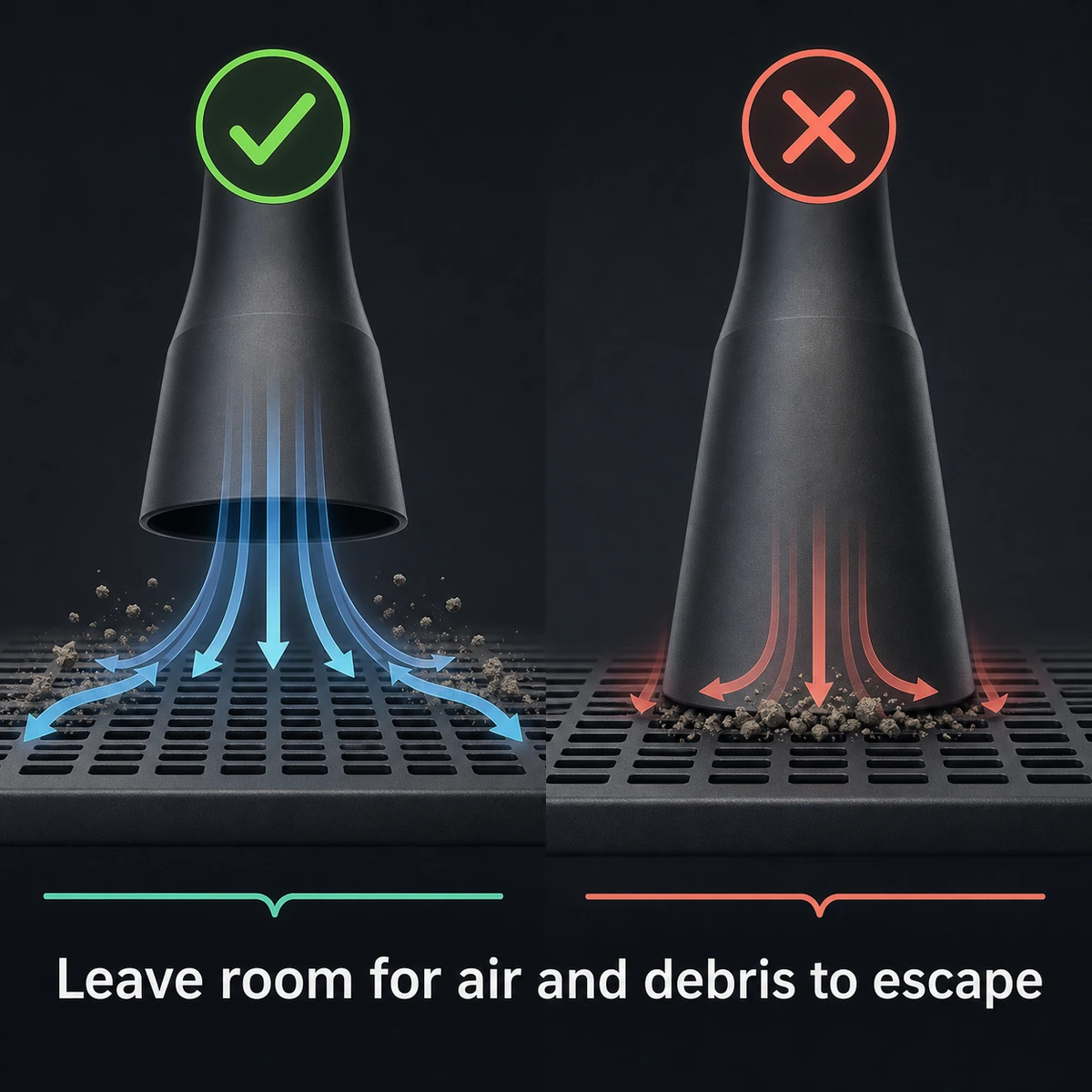
A focused nozzle can reach key gaps, vent slats, seams, and tracks. Leave enough space for the incoming air and loosened material to escape. If you press a nozzle tightly against a grille, you can block the flow or drive debris in an unhelpful direction. A soft brush may loosen surface dust on a compatible grille or textured area, but it should not be used on a display, polished trim, sensor, or fragile finish unless the equipment maker permits contact.
Check that attachments lock securely and are identified for the model you are buying. Do not assume that a nozzle shown with one model fits another. Avoid improvised adapters: an insecure fitting can detach, obstruct airflow, or place the outlet too close to the target.
The buying test is simple. List the three places you clean most often, note the size and sensitivity of each opening, and decide where the dust can exit. Then check the supplied attachment list against those actual jobs.
Read charging and runtime claims with their conditions attached
Rechargeable tools trade disposable cans for a battery, charging time, heat management, and eventual battery aging. That can be convenient for repeat cleaning, but the numbers need context.
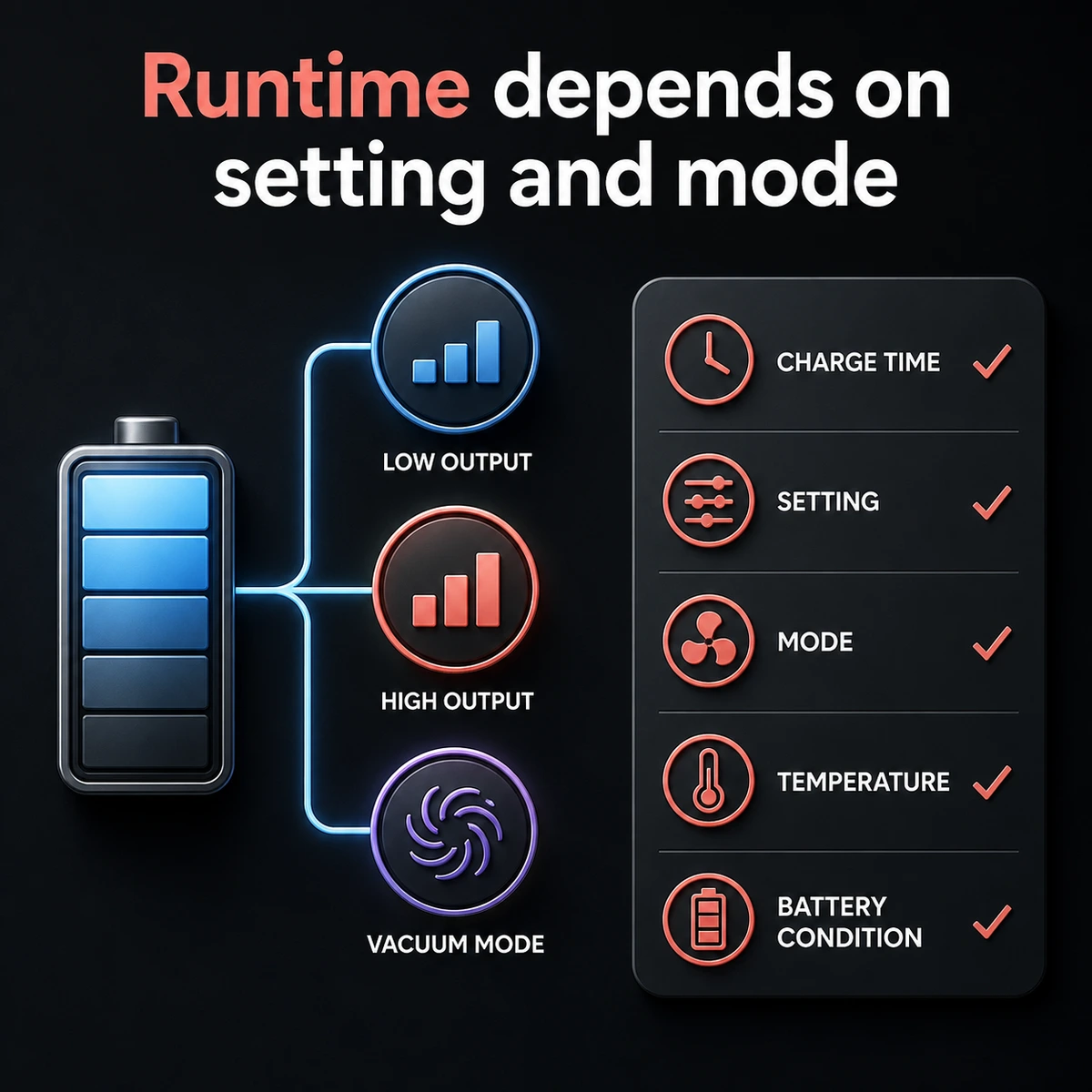
Battery capacity, stated in milliamp-hours (mAh), is not a standalone runtime promise. Motor load, selected output, vacuum mode, temperature, battery condition, and control electronics all affect operating time. “Up to” runtime usually describes a favorable condition, often a lower setting. It should not be rewritten as the expected duration at maximum output.
This is the right way to read any listing. Prefer conditions and caveats over a large isolated number. A seller that distinguishes low-output runtime from maximum-output use gives you more decision value than one that simply says “long-lasting.”
Charge on a stable, dry, uncovered surface with a suitable cable and power source. Keep vents open. If the body becomes unusually hot, damaged, or swollen, stop using the tool and contact the seller or manufacturer rather than continuing to charge it.
- FT-03: USB-C charging, about two hours for a typical full charge, with up to about two hours stated at lower airflow. Battery capacity is not published on the current product page.
- FT06: a stated 10,000 mAh battery and about three hours for a typical USB-C charge. Runtime varies by speed and operating mode; conflicting supplied maximum-runtime figures are not published as one definitive claim.
Compare documentation, not just the feature tiles
A buying guide cannot confirm long-term durability without controlled evidence, and a product page cannot substitute for the instructions of the equipment you plan to clean. Still, documentation quality is something you can assess before purchase.
Compliance language also needs precision. An FCC Part 15B electromagnetic-compatibility test report, where applicable, concerns unintentional radio-frequency emissions from a digital device. It is not a general certification of cleaning performance, battery life, drop resistance, or safety for every electronic device. Keep the test scope attached whenever the report is mentioned.
- A model number that is consistent across the listing, manual, and support page
- Defined controls and shutdown behavior
- Charging input and typical charging time
- Runtime wording tied to speed or mode
- A list of compatible attachments
- Filter installation and drying instructions if vacuum mode is included
- Warnings about liquids, blocked motor openings, heat, and damaged batteries
- A support route for unresolved questions
How to choose an electric air duster in five minutes
Use this short decision path before comparing prices:
If the two POWCUBE patterns fit your shortlist, you can compare FT-03 and FT06 side by side rather than treating their maximum RPM figures as the whole decision. The Air Duster use, charging, and care guidance is also worth reading before purchase because it shows the operating steps and maintenance each design requires.
- Define the debris: loose dry dust, crumbs, lint, or material that should be collected rather than redistributed.
- Define the target: an external grille, key gap, car seam, track, or open surface. Follow the target manufacturer’s instructions.
- Choose the workflow: select air-only for controlled displacement or blow-and-vacuum when pickup is part of the same task.
- Check control and attachments: make sure you can begin low and that a secure, compatible nozzle fits the opening without sealing it.
- Check qualified specifications: keep RPM, airflow, pressure, suction, battery capacity, charge time, and runtime as separate measures.
A practical final check
Write down your three repeat cleaning jobs, whether the dust must be collected, and the lowest output each surface needs. Eliminate any product whose controls, attachments, runtime conditions, or care instructions are unclear. The right electric air duster is the one whose documented workflow fits those jobs, not the one with the loudest isolated number on the box.